

Your consumer products news reporter
Provided by AGP
Governor's 2026 May Revision: Quick Summary
Riding Artificial Intelligence (AI) Coattails. Tax revenues associated with the AI industry continue to shore up California’s budget, at least for now. Compared to the Governor’s January budget, the May Revision reflects General Fund tax revenues that are higher by $16.5 billion over the three-year budget window through 2026-27. Nearly $14 billion of this total comes from higher personal income taxes, and the vast majority of that is associated with receipts for the 2025 tax year.
The nonpartisan Legislative Analyst’s Office (LAO) projected last week that tax revenues would exceed the January estimates by $25 billion over the budget window, so the Governor’s proposal reflects lower revenues than that estimate, although the difference is relatively small as a percent of the budget.
Tax Increases Are Largest Part of Proposed Solutions. The May Revision proposes $8.9 billion in new budget solutions across 2025-26 and 2026-27, which are summarized in the chart below. Notably, 40 percent of the solutions are tax increases, while only 5 percent are spending reductions.
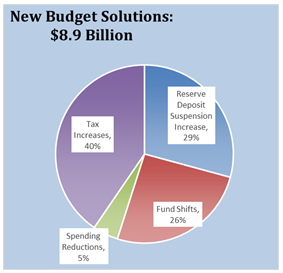
Major components of these solutions for 2026-27 include the following:
-
Tax increases of $3.6 billion in 2026-27, which would increase to $5.1 billion by 2027-28. These include the following:
$850 million by limiting business credit use to either $5 million or 50 percent of tax liability.
$450 million by broadening sales taxes to include certain software services, which would rise to $900 million by 2029-30. This sales tax increase would also raise local tax revenue by $560 million in 2026-27 and $1.1 billion annually.
$575 million by increasing and revising managed care organization (MCO) taxes starting in 2027. The revenue increase would rise to $2.3 billion in 2027-28.
Spending reductions of $411 million, including $278 million by reducing Medi-Cal asset limit thresholds back to previous levels (as described under the Health section below).
Shifting $2.3 billion in costs from the General Fund to other state funds, including $1.9 billion to MCO funds and $212 million to the Behavioral Health Services Fund.
- $2.6 billion by increasing the January proposal to suspend the state’s 2025-26 deposit into the Rainy Day Fund. The May Revision would increase that suspension amount to $5.4 billion. The effect of suspending the deposit is similar to withdrawing funds from reserves, a move that makes no fiscal sense during a time of rising tax revenues.
Insufficient Spending Solutions Leave Long-Term Deficits. The January budget estimated a deficit of $2.9 billion for 2026-27 and a much larger deficit of $22 billion for 2027-28. The May Revision now proposes budgets that are technically balanced through 2027-28, as indicted by ending balances totaling $4.5 billion and $2.1 billion in the Special Fund for Economic Uncertainty (SFEU). A major factor in this improvement is that tax revenues for 2025-26 and prior years significantly exceeded expectations, creating a carry-in balance of $28 billion going into 2026-27, as shown in the chart below.
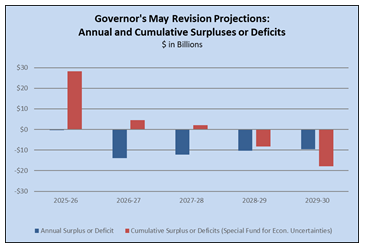
While striving to achieve balance in future years is commendable, the lack of significant, ongoing spending reductions means that revenues and expenditures would remain fundamentally out of balance for the duration of the budget forecast. The annual deficits, which range from $10 billion to $14 billion in future years, already assume that the Governor’s proposed solutions are enacted, meaning that additional actions would be needed to achieve a truly sustainable budget.
Longer-Term Expenditures and Revenues Improve Slightly. Estimated General Fund expenditures for 2026-27 would decrease slightly compared to January, dropping by $1.8 billion to $247 billion. In following years, expenditures would be lower than January projections by $7 billion to $8 billion per year. When adding other state funds to the General Fund, total state spending would reach $349 billion.
General Fund revenues in 2026-27 would reach $236 billion, which is $6 billion higher than January’s estimate. Over the longer term, General Fund revenues are higher than January estimates by $6 billion to $7 billion per year.
“Wall of Debt” Belies Governor’s Claims of Balanced Budgets. The nonpartisan LAO documented in a February 2026 report how Governor Newsom and legislative Democrats rebuilt the “Wall of Debt” in recent budgets to pay for ongoing spending. Governor Jerry Brown had reduced the Wall of Debt to $2 billion by the end of his tenure, but Governor Newsom drove that debt back up to $34 billion. The May Revision proposes only modest adjustments to that debt, leaving the outstanding balance likely in the range of $32 billion. Use of budgetary borrowing to this degree demonstrates that California’s budget is only balanced according to a technical definition. Any family with common sense would recognize that amassing credit card debt to pay regular bills cannot be considered keeping a budget in balance. Governor Newsom would leave that debt for future taxpayers to address.
The Wall of Debt balance is in addition to the $18 billion debt owed to the federal government for unemployment insurance claims. California is the only state that failed to pay off its debt following the pandemic. As a result, employers face steadily increasing taxes to pay down the debt balance, while the state General Fund must pay the annual interest, amounting to $668 million in the upcoming year.
Health
Another MCO Tax Will Increase Health Insurance Premiums on Californians. The Governor proposes yet another managed care organization (MCO) tax, even though H.R. 1 greatly altered how states could structure Medi-Cal provider taxes. This new MCO tax, levied on health care plans, is projected to add $575 million in new revenue for 2026-27 and about $2 billion annually until 2029-30. Unlike previous MCO tax structures, though, this new tax would hit commercial health insurance plans much harder, which would directly increase the cost of health care insurance premiums on most Californians, making this state even more unaffordable.
Stealing More MCO tax from Medi-Cal Providers. Instead of increasing Medi-Cal reimbursement rates to Medi-Cal providers using the existing MCO tax revenue, as the Governor is required to do by Proposition 35, the Governor is yet again stealing more MCO tax revenue for budget savings of $1.9 billion. If this funding were used for hospitals instead, many distressed hospitals would not be on the brink of closure.
$50 Million for Distressed Hospitals. Realizing that the recently enacted AB 108’s $25 million in the current fiscal year was not enough to save all the hospitals at risk of closure this year, the Governor adds $50 million General Fund to the small grant program to immediately help more hospitals. While this funding is welcome, it is far from the Senate Republican request of $300 million in additional relief for distressed hospitals.
H.R. 1-Related Workload Funding for the Counties. County governments have been sounding the alarm that the required Medi-Cal and CalFresh eligibility changes from H.R. 1 will create a large administrative burden for county employees. The May Revision includes $262 million ($74 million General Fund) in 2026-27 and $33 million ($16.7 million General Fund) per year in 2027-28 and
2028-29 to provide the counties with additional state support.
Addressing Some Medi-Cal Fraud, But Possible Impact on the Developmentally Disabled. The Governor attempts to address some of the recent Medi-Cal fraud issues in the news (such as the Bay Area taxi issue) through new utilization management tools for Medi-Cal managed care plans to discourage overbilling. The tools will also be used for applied behavioral analysis (ABA) therapy, a common therapy for children with autism. While it will potentially weed out fraudulent Medi-Cal billing, it is unknown how this new utilization requirement could negatively impact care to the developmentally disabled. The Governor scores $68 million in 2026-27 and $552 million in future years from these efforts.
Return of the Medi-Cal Asset Test. The Medi-Cal asset test requires low-income seniors and the disabled to spend down their funds before they can enroll in Medi-Cal. Despite the Legislature’s 2025 action to resume a $130,000 asset test for Medi-Cal eligibility, the Governor’s May Revision proposes a return of the pre-2022 limit of $2,000 for individuals and $3,000 for couples, effective January 1, 2027. This is the limit in the amount of assets that a senior or disabled individual can hold to be able to apply for Medi-Cal. The Governor scores $279 million in savings in 2026-27 to reinstate this asset test, which can only be achieved by temporarily denying coverage to these low-income individuals.
Moving Undocumented Individuals Enrolled in Medi-Cal Out of Managed Care Plans. The Governor’s May Revision proposes to move undocumented individuals currently enrolled in Medi-Cal managed care plans out of those plans and into fee-for-service direct billing on January 1, 2027. The Governor estimates savings of $472 million General Fund in 2026-27 and $1.2 billion in future years from this action. The May Revision presents this as a “baseline” change to comply with federal law, rather than a budget savings proposal. Although this action helps the budget, the remaining costs of covering the undocumented within Medi-Cal is still more than $12 billion annually.
Increasing Medi-Cal Premiums for Undocumented Individuals. The Governor scores $427 million in savings in 2027-28 and $314 million annually thereafter by increasing the monthly premiums levied on undocumented adults (ages 19-59) from $30 per month to $50 per month, effective July 1, 2027. The 2025 Budget Act included $30 per month premiums as solution to future deficits. Despite this premium increase, the May Revision still maintains coverage to more than 1.5 million undocumented individuals.
Delay of Medi-Cal Disenrollment for Legal Non-Citizens. The Governor’s January budget proposal included a disenrollment of roughly 200,000 legal non-citizens (like refugees) from Medi-Cal on October 1, 2026. While the May Revision delays this disenrollment to July 1, 2027, increasing General Fund costs by $668 million General Fund, it still maintains the bizarre scenario of kicking off legal non-citizens from Medi-Cal while protecting coverage for undocumented individuals.
Expansion of Covered California State Subsidy Program. The Governor’s May Revision proposes to expand the state subsidy program that helps reduce the health insurance premium costs for low-income individuals and families that purchase insurance through Covered California. The program is funded by the mandate penalty levied on those Californians that do not have health insurance coverage. The proposal expands the eligibility limit of the program from 165% of federal poverty level (about $26,000 for individuals and $53,000 for a family of 4) to 200% of federal poverty level (about $31,000 for individuals and $64,000 for a family of 4), at an additional cost of $110 million annually.
Raises Taxes with a Permanent Cap on Research and Development Tax Credit. The Governor’s May Revision proposes to establish a permanent cap on business tax credits at either $5 million or 50 percent of tax liability, depending on whichever is greater. This tax increase is projected to result in $850 million General Fund in 2026-27, growing to $1.8 billion by 2029-30.
Expands Sales and Use Tax to Services. The Governor’s May Revision proposes to increase revenue by expanding the state and local sales and use tax to include taxation on digital prewritten software as well as software as a service. The May Revision includes additional General Fund revenue of $450 million in2026-27, growing to $900 million by 2029-30. In addition to state revenues, local sales and use tax revenue is projected to increase by $560 million in 2026-27 and by $1.1 billion annually thereafter as a result of this change.
Minor Tax Relief for New Businesses. The Governor’s May Revision proposes to reduce the $800 annual tax paid by limited liability companies, limited partnerships, and limited liability partnerships in their first year to $400 during the 2027, 2028, and 2029 tax years. The proposal could impact approximately 250,000 new businesses and is projected to provide $100 million in tax relief each year. This minor tax policy change would impact new businesses only, failing to relieve the tax burden of California’s established businesses unfortunately.
Proposition 98 Guarantee. At May Revision, the Proposition 98 guarantee levels are estimated to be $125 billion in 2024-25, $125 billion in 2025-26, and $127 billion in 2026-27, reflecting an increase of $6.4 billion compared to the Governor’s January budget. This also reflects an increase of $28 billion over the three-year budget window compared to estimates at the 2025 Budget Act. According to the Department of Finance, most of the funding increase is required to go towards the Proposition 98 Reserve, which is discussed in more detail below. The May Revision maintains a $3.9 billion settle-up for 2025-26, down from $5.6 billion at the Governor’s January budget. Per pupil spending is at a record high of $21,013 Proposition 98 and $28,282 when accounting for all funds. This is an increase of nearly 80 percent in Proposition 98 per pupil spending since the 2019 budget and 66 percent when accounting for total funds.
Proposition 98 Reserve and Local Control Funding Formula. The Governor’s January budget projected a final balance in the Public School System Stabilization Account (Proposition 98 Reserve) of $4.1 billion at the end of 2026-27. Under the May Revision, the final balance would be $10.3 billion. This reflects $8.7 billion in mandatory deposits over the three-year budget window and an increase in a discretionary deposit from $240 million to $1.6 billion.
The January budget included a 2.41 percent cost-of-living (COLA) adjustment for the Local Control Funding Formula (LCFF), and the May Revision increases this COLA to 2.87 percent, resulting in an increase of $1.3 billion in discretionary funds for Local Education Agencies (LEAs) compared to the 2025 Budget Act. The May Revision also includes a discretionary “super COLA” of $907 million which results in a total COLA of 4.31 percent when also accounting for the statutory COLA.
More Funding for Special Education. The Governor’s January budget included $509 million to increase special education base rates to $999 per pupil, the May Revision adds an additional $1.8 billion, bringing the per pupil base rate to $1,340. The Administration notes that this would be a nearly $2.4 billion increase in special education funding compared to the 2025 Budget Act, or an increase of 43 percent.
Student Support and Professional Development Discretionary Block Grant. The Governor’s January budget proposed $2.8 billion one-time Proposition 98 General Fund for the Student Support and Professional Development Discretionary Block Grant. The May Revision increases the proposed funding by $2.2 billion for a revised grant total of $5 billion. This is in addition to $1.7 billion provided in the 2025-26 budget. Providing a one-time discretionary block grant gives schools more flexibility to cover costs that are specific to their individual priorities without creating ongoing funding pressure.
Requires Paid Pregnancy Leave. The May Revision includes a new proposal to require all TK-12 LEAs and community colleges to provide employee with up to 14 weeks of paid pregnancy disability leave beginning in 2026-27. The Administration notes that the costs of the benefit are absorbable withing the 1.4 percent discretionary LCFF COLA.
The May Revision largely maintains the Governor’s January proposals for the University of California, California State University, community colleges, and financial aid. Community colleges, which are funded under Proposition 98, would receive cost-of-living adjustments similar to those described above for TK-12 schools.
Housing and Homelessness
Provides Funding for Disaster Rebuilding. The May Revision proposes $56 million General Fund and $44 million in existing National Mortgage Settlement funds (originating from the Great Recession housing crisis) to establish a Disaster Rebuilding Fund intended to allow access to construction and renovation financing for disaster-impacted homeowners.
No New Funding for Homelessness Programs. The May Revision proposes no new funding for homelessness programs above the existing $500 million General Fund for the Homeless Housing, Assistance and Prevention program, which is contingent on additional accountability and performance requirements.
Natural Resources and Environment
Natural Resources and Environmental Priorities Continue Despite Budget Constraints. The May Revision continues the Administration’s existing natural resources and environmental priorities through targeted investments in ecosystem restoration, outdoor access, wildlife management, and air quality research, despite broader budget constraints. Key proposals include:
Up to $125 million one-time Proposition 4 funding for acquisition of the Golden Gate Fields property for future shoreline park, recreation, and open space access uses.
An additional $25 million one-time General Fund augmentation for the Healthy Rivers and Landscapes Program to support environmental flows, habitat restoration, science, and monitoring associated with the Bay-Delta Water Quality Control Plan update.
Shift of General Fund Costs to Alternative Funds. The May Revision proposes shifting $9.6 million in ongoing General Fund costs within the California Environmental Protection Agency to alternative fund sources, including Department of Toxic Substances Control emergency response activities, Office of the Secretary for Environmental Protection operational costs, and California Air Resources Board administrative activities. The proposal continues the Administration’s broader effort to reduce General Fund pressure by relying on special fund revenues to support certain regulatory and administrative functions.
Gas Taxes Increase Again. Despite claims to prioritize affordability for Californians, the Governor proposes no changes to existing gas tax law, continuing the automatic annual tax increases to gasoline and diesel fuel. Updated estimates reflect an increase of 3.6 percent for gasoline taxes, which would increase by 2.2 cents per gallon (cpg) to 63.4 cpg. Diesel fuel taxes would rise by 3.4 percent, reflecting an increase of 1.6 cpg, to 48.2 cpg on July 1, 2026. These increases result in the state collecting an additional $327 million in fuel taxes in 2026-27.
Clean California and Homeless Encampments. The May Revision proposes a one-time allocation of $40 million General Fund for the Clean California program, focused on targeted litter abatement, proper waste disposal, and encampment resolution. General Fund spending of $6.2 million annually is also proposed to support homeless encampment liaisons to connect homeless persons encamped on state highway right-of-way with services.
No New Funding for Proposition 36. Despite the overwhelming mandate from the nearly 70 percent of voters who supported Proposition 36 (2024), the Governor continues to underfund the measure by hundreds of millions of dollars. The May Revision fails to provide any new funding for the measure, leaving key stakeholders like county probation departments, district attorneys, and front-line law enforcement to implement the law without adequate resources. It seems the Governor is intent on setting up this popular public safety measure for failure.
Antitrust Funding Could Exacerbate Cost of Living Challenges. The May Revision includes $14 million for the Department of Justice to continue its antitrust litigation against oil companies, among others. California has already regulated oil and gas companies into near-extinction within the state. As the few that remain seek to maintain profitability by consolidating operations, the Attorney General will be looking to sue them over alleged antitrust violations. Monopolization concerns are valid in industries with many otherwise willing suppliers. However, when overregulation drives out would-be competitors, suing the few remaining suppliers may not actually preserve competition. Instead, it could increase the costs borne by the small number of remaining suppliers, which is likely to drive up consumer costs further. Californians already face some of the highest fuel prices in the nation. Funding counterproductive attacks on oil companies is likely to drive energy prices higher still. Secondarily, costs of consumer goods that must be shipped will go up as the costs of fuel increase.
General Government
Additional Handout to the State’s Media. The May Revision proposes $10 million General Fund annually in 2026-27 and 2027-28 for the California Civic Media Program. This program was established in the 2025 Budget Act with $10 million General Fund. During 2025-26 budget deliberations, Senate Republicans expressed concerns about using taxpayer dollars to support potentially biased media outlets, but the Governor continues to prioritize the state’s media outlets with two years of additional funding, one year after his term as Governor ends.
Unemployment Insurance (UI) Debt Interest Payment. The state is responsible for interest due on money borrowed from the federal government for UI benefit payments. The outstanding loan is currently $18 billion. The annual interest payment for 2026-27 is updated to $668 million, an increase of $6 million over January estimates, reflective of continued borrowing to pay benefits as California’s unemployment rate remained at 5.3 percent in March, significantly above the national average of 4.3 percent.
Adjustments to In-Home Supportive Services (IHSS). The May Revision includes two adjustments to the IHSS program. The first is an increase of $31 million General Fund in 2026-27 to conform IHSS to the delayed transition to restricted-scope Medi-Cal for those impacted by the federal changes to eligibility for qualified non-citizens to July 1, 2027. The second is a reduction of $63 million General Fund in 2026-27 to conform IHSS with the changes to the Medi-Cal asset limit for seniors and disabled adults back down to $2,000 for an individual and $3,000 for a couple. On May 13th, the federal Centers for Medicare & Medicaid Services (CMS) announced a deferral of $1.1 billion in federal funding tied to the IHSS program. This is a developing situation and will be closely monitored to determine the potential impacts on the IHSS program.
Additional Funding for Immigration Legal Services. The May Revision includes $20 million one-time General Fund to increase support for undocumented immigrants facing immigration court proceedings. The Administration notes that the funding will be used to “support legal strategies that increase legal capacity.” Additional details on this proposal are not yet available.
CalWORKs Grant Increase. The May Revision includes a CalWORKs Maximum Aid Payment (MAP) increase of 1.8 percent, estimated to cost $60 million in 2026-27. This increase is funded entirely by the Child Poverty and Family Supplemental Support Subaccount, a fund source that the state previously realigned to counties. While this expansion is being covered by the subaccount, it should be noted that if the subaccount ever has insufficient funding to cover this increase or any prior grant increases, General Fund will be used to backfill the difference.
More Funding For CalFood. The May Revision includes a one-time increase of $30 million General Fund for the CalFood program, which provides funding for food banks to purchase, store, or transport food grown or produced in California. This increase is in addition to the CalFood program baseline funding level of $8 million General Fund.
Increases Age for Adult Protective Services. The May Revision includes a decrease of $70 million General Fund in 2026-27 and ongoing to reflect a revision of the expansion of Adult Protective Services, changing the age of eligibility from 60 back to 65.
Legal Disclaimer:
EIN Presswire provides this news content "as is" without warranty of any kind. We do not accept any responsibility or liability for the accuracy, content, images, videos, licenses, completeness, legality, or reliability of the information contained in this article. If you have any complaints or copyright issues related to this article, kindly contact the author above.
